
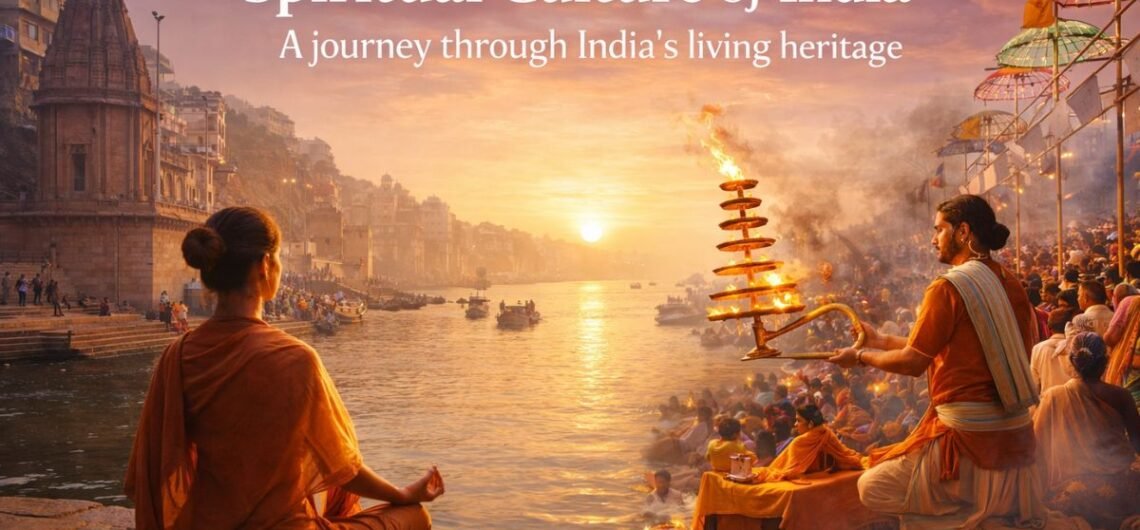
India is a land where ancient history and spirituality are woven into everyday life. In Indian cities and villages alike, the rhythms of the day are marked by prayers, temple bells and family rituals — reflecting rich traditions that endure across millennia.
Yoga, temple worship and colorful festivals are not mere relics — they are living practices that shape daily life. These elements together form India’s “timeless spirit,” inviting both Indians and visitors to experience a culture where the sacred and the ordinary flow into one another.
India is a land where spirituality is part of everyday life. If you want to explore this deeply, check out our spiritual India tour experiences.
Yoga — The Ancient Path to Inner Balance
Yoga originated in ancient India over 5,000 years ago as a holistic system for uniting mind, body and spirit. Taught through a master–disciple tradition, it was codified in scriptures like the Yoga Sutras of Patanjali.
UNESCO recognizes yoga’s philosophy — aiming to “unify the mind with the body and soul” for greater well-being — as having profoundly shaped Indian society.
Core Elements of Traditional Yoga
• Physical postures (āsanas) for health and flexibility
• Meditation (dhyāna) for mental stillness
• Breath control (prāṇāyāma) for energy management
• Ethical living (yamas & niyamas) as a foundation
• Pursuit of self-realization and release from suffering
Yoga in Modern India & the World
In India today, yoga remains inclusive — “practised by the young and old without discriminating against gender, class or religion.” Millions begin or end their day with Surya Namaskar (sun salutations) or quiet mantra chanting.
Globally, India’s gift of yoga has resonated widely — from Rishikesh ashrams to city studios on every continent, the practice now has billions of devoted practitioners.
Yoga is not just exercise but a way of life. Many travelers now book yoga retreats in India to experience authentic learning.
Temples — Sacred Spaces of Faith & Architecture
Regional Architectural Styles
• North Indian (Nagara): Tall, curving shikhara towers over the inner shrine
• South Indian (Dravidian): Stepped pyramidal vimanas above the sanctum
• Common layout: A garbhagṛha (sanctum) housing the deity, surrounded by concentric corridors
Temples as Community Centers
Temples are far more than stone and stucco — they are living centers of culture. In every town or village, the temple hosts festivals, music, dance and ritual gatherings that bind the community together.
Craft traditions — carving, painting and textile arts — have flourished under temple patronage for centuries. Pilgrims and tourists visiting famous temple towns support local economies, making temples the lifeblood of small towns.
Notable temple destinations: Varanasi on the Ganges, the grand Shiva shrine at Tanjore, and the temples of Khajuraho — all UNESCO World Heritage Sites.
Traditions That Live Through Generations (Festivals & Celebrations)
Across India, age-old traditions thrive in daily routines and grand celebrations. Festivals mark seasons and history:
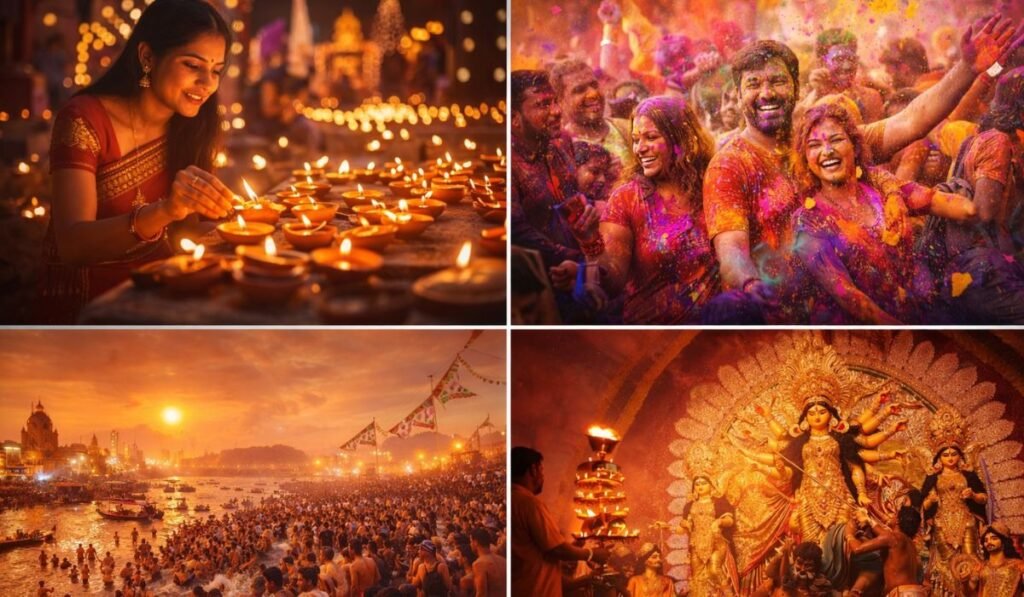
• Diwali — The Festival of Lights; good triumphing over evil
• Holi — The spring color festival; joy and renewal
• Kumbh Mela — UNESCO-recognized; world’s largest spiritual gathering
• Durga Puja (Kolkata) — UNESCO-listed for its deep communal roots
• Harvest fairs, New Year festivals, and local saints’ days
Tradition Meets Modernity
These customs evolve without losing their essence. Craftsmen blend new motifs into centuries-old crafts — block-printed fabrics, brassware and handloom saris — while village artisans use online galleries to keep folk art alive.
Spirituality in Everyday Indian Life
In India, reverence and mindfulness are woven into ordinary actions. Many families begin the day with a small puja at a home altar — lighting incense or a lamp — and give thanks before meals.
“Atithi Devo Bhava” — The Guest is God
Hospitality is a sacred duty in India. It is common for travelers to experience this warmth firsthand: a taxi driver offering water, or a shopkeeper giving a blessing with tika (vermilion) as a sign of goodwill.
Reverence for Nature
The traditional Hindu worldview sees rivers, mountains, trees and animals as manifestations of the divine. The Ganges is worshipped as a goddess; many communities maintain sacred groves where cutting a tree is taboo.
In Hinduism, people believe that the same Divine source creates all of creation, so they see everything as sacred. This translates into vegetarian diets, honoring cows, planting trees, and a deep ethic of unity with nature.
Why India’s Timeless Spirit Attracts the World
Nearly 60% of India’s domestic travel is now for spiritual or wellness purposes. International visitors flock to yoga retreats, temple festivals and ashrams in growing numbers.
Destinations like Rishikesh and Auroville host world-class yoga and meditation courses, while pilgrim hubs such as Varanasi and Haridwar buzz with devotional energy.
Visitors often describe coming to India seeking something deeper — and finding a chance for inner transformation amid its calm, tradition-steeped surroundings. India’s appeal is not just in what you see, but in how you feel.
Conclusion
Yoga, temples and traditions together define the soul of India. Yoga’s pursuit of inner balance, the temple’s role as a community focal point, and the multi-generational customs from festivals to family rituals all share a unifying ethos.
These threads of India’s heritage are not frayed; rather, they are woven into the fabric of modern life. By preserving and practicing them today, India keeps its ancient spirit alive — and offers every visitor a chance to touch the eternal.
The real magic of India’s timeless spirit is that it continues to inspire respect, transformation and a sense of unity long after one leaves its shores.

Comments