
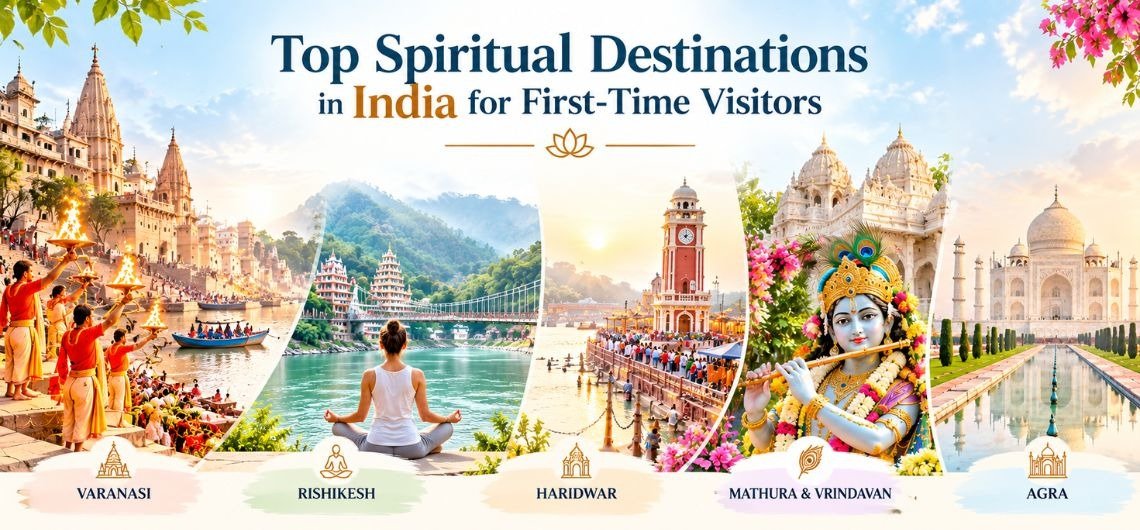
India’s spiritual life does not sit in one place or one tradition. It shows up in riverside ceremonies at dusk, in temple lanes filled with devotional singing, and in ashrams where the day begins with yoga before sunrise. For many travellers, visiting these places is one of the most meaningful ways to understand how faith shapes everyday life in India.
If this is your first trip, the questions come quickly. Which of the top spiritual destinations in India for first-time visitors suits your interests? What customs should you know? How long does it take to travel between cities? This guide covers Varanasi, Rishikesh, Haridwar, Mathura and Vrindavan, with Agra as a heritage companion, and gives honest planning advice for each.
Quick answer: For a first spiritual trip through North India, start with Varanasi for ancient river rituals, Rishikesh for yoga and meditation, Haridwar for its grand Ganga Aarti, and Mathura and Vrindavan for Krishna devotion. Agra adds Mughal heritage to the route. Choose two or three places rather than all five, because the travel between them is considerable.
Why Explore India’s Spiritual Destinations on Your First Visit?
Spiritual places show India at its most alive, and a single trip can include very different experiences:
- Temple visits: Devotees come for darshan, the act of seeing and being seen by the deity, often in crowded, music-filled halls.
- River ceremonies: The Ganges is sacred in Hindu belief, and evening aarti ceremonies offer lamps, chanting and bells to the river.
- Yoga and meditation: Classes, ashram routines and quiet riverside mornings give a journey a slower rhythm.
- Local traditions: Festivals, devotional music and vegetarian food make everyday culture visible.
You do not need to share the faith to attend respectfully as an observer. Most public ghats welcome visitors, but rules differ from temple to temple, and some restrict phones, cameras or bags. Checking before you go matters more here than at most attractions.
Top Spiritual Destinations in India for First-Time Visitors
Each destination below offers a different kind of experience. Suggested stay lengths are planning recommendations, not fixed rules.
| Destination | Best known for | Suggested time (planning recommendation) |
| Varanasi | River rituals, ghats, ancient temples | 2 nights |
| Rishikesh | Yoga, meditation, ashrams | 2 to 3 nights |
| Haridwar | Har Ki Pauri and its Ganga Aarti | 1 night, or a half day |
| Mathura and Vrindavan | Krishna temples, devotional music | 1 night |
| Agra | Mughal heritage on a wider route | 1 to 2 nights |
Varanasi
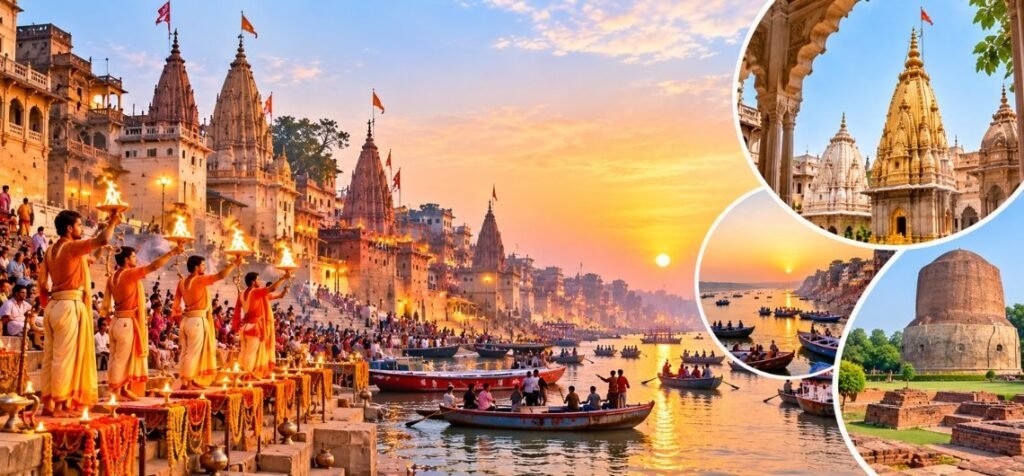
Why it matters: Varanasi, also called Kashi or Benares, is often described as one of the world’s oldest continuously inhabited cities. In Hindu tradition it is Shiva’s city, and bathing in the Ganges or performing last rites here is considered especially meaningful.
What to explore: The ghats, long stone stairways to the river, come alive at dawn and dusk. Dashashwamedh Ghat hosts the best-known evening Ganga Aarti, which begins around sunset, so the start time shifts with the seasons. It is free to watch, and arriving 45 to 60 minutes early helps you find a place. Kashi Vishwanath Temple is one of Shiva’s twelve Jyotirlinga shrines; phones, cameras and bags are generally not allowed inside, so use the lockers near the entrances and expect security checks and queues. Sarnath, just outside the city, is a calmer stop associated with the Buddha’s first sermon.
What first-time visitors can expect: Narrow lanes, noise and crowds. Some ghats are used for cremations; keep your distance and never photograph them. Ask before photographing worshippers.
Suggested time (planning recommendation): Two nights.
Best time to visit: October to March is cooler, while summers are very hot. Festival periods such as Kartik Purnima bring longer ceremonies and bigger crowds.
Planning note: Most travellers fly or take an overnight train from Delhi, so Varanasi suits a longer trip, such as the Golden Triangle tour with Varanasi, which pairs the city with Delhi, Agra and Jaipur.
Rishikesh
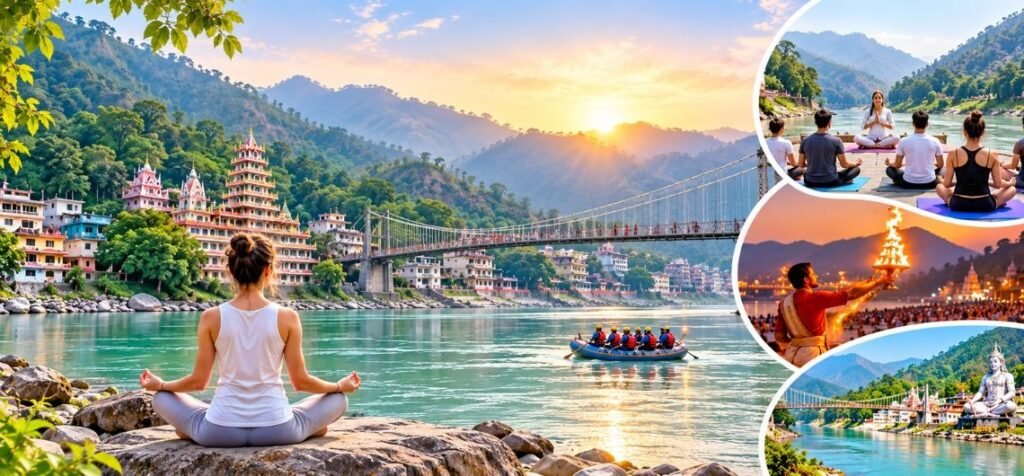
Why it matters: Set where the Ganges leaves the Himalayan foothills, Rishikesh is widely known as a yoga capital and a base for ashram life. Its mood is quieter than Varanasi’s.
What to explore: Triveni Ghat holds an evening Ganga Aarti around sunset. Parmarth Niketan, a large ashram, is also known for its evening aarti and yoga programmes. Ram Jhula and Laxman Jhula, two suspension bridges, give river views, and Geeta Bhawan and Swarg Ashram are quiet places for reflection.
What first-time visitors can expect: A slower pace, riverside walks and the chance to learn: a drop-in class, a meditation session or an ashram talk. Many ashram areas are vegetarian and alcohol-free, and some keep quiet hours. Travellers who prefer structured wellness to drop-in classes can explore India yoga tour packages, though programmes and inclusions vary by tour.
Suggested time (planning recommendation): Two to three nights.
Best time to visit: October to April is generally pleasant. The monsoon brings heavy rain.
Haridwar
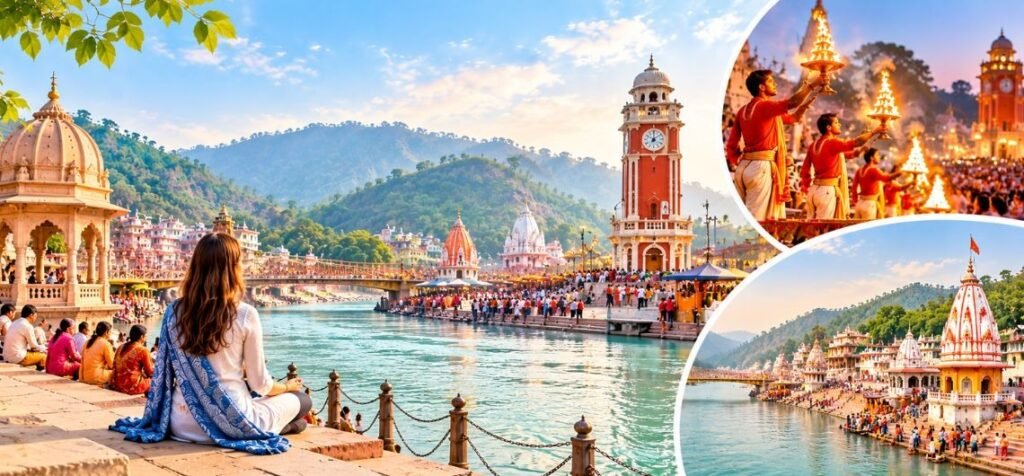
Why it matters: Haridwar is where the Ganges enters the plains. It is one of the major pilgrimage towns in Hindu life and is often called a gateway to the Char Dham pilgrimage.
What to explore: Har Ki Pauri is the town’s most sacred ghat, with an aarti at sunrise and sunset every day. Priests chant, lamps float on the river and the crowd is dense. Sunset times change through the year, roughly from 5:15 pm in January to 7 pm in June, so confirm locally. Mansa Devi Temple sits on Bilwa Parvat hill above the town.
What first-time visitors can expect: More spectacle and less calm than Rishikesh. Bathing in the Ganges is an act of devotion. Watching from the steps is fine; if you bathe, follow local guidance because currents can be strong, remove shoes before the ghat steps, and ask before photographing people.
Combining it with Rishikesh: The two towns are about 25 km apart. A common approach is the sunset aarti in Haridwar and Rishikesh the next morning. The Golden Triangle tour with Haridwar and Rishikesh shows how both towns can be added to a Delhi, Agra and Jaipur itinerary.
Suggested time (planning recommendation): One night, or a half day as an add-on to Rishikesh.
Best time to visit: October to March. Avoid major festival periods, including the Kumbh Mela, unless you are prepared for very large crowds.
Mathura and Vrindavan
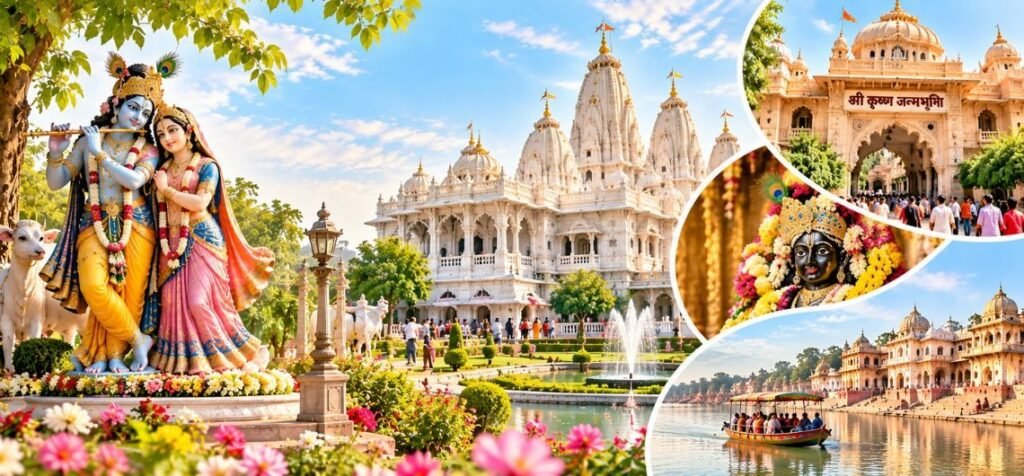
Why it matters: Mathura is revered as Krishna’s birthplace and Vrindavan as the setting of his childhood. The two towns lie roughly 12 to 15 km apart.
What to explore: In Mathura, Shri Krishna Janmabhoomi marks the site traditionally held to be his birthplace. Security is strict, and phones, cameras and bags are not allowed inside, though cloakrooms are nearby. In Vrindavan, Banke Bihari Temple is known for a darshan style in which a curtain is repeatedly drawn and opened. Its lanes are narrow and crowded, shoes come off, and photography is generally not allowed inside. ISKCON Temple, familiar to many international visitors through the Hare Krishna movement, is also in Vrindavan.
What first-time visitors can expect: Devotional music, flower and sweet offerings, and some of North India’s biggest temple crowds. At Holi in March the towns turn colourful and boisterous, so wear clothes you do not mind staining. Many temples close for a midday break and keep seasonal hours, so check current schedules. Crowd pressure can be extreme: Banke Bihari’s management asked devotees to avoid Vrindavan from 29 December 2025 to 5 January 2026.
Suggested time (planning recommendation): One night. A day trip is possible but tiring: Delhi to Mathura takes about three hours by road, and Agra to Mathura about one to one and a half.
Best time to visit: October to March, with Holi in March and Janmashtami in late summer as the festival peaks.
Planning note: Because the towns lie along the Delhi–Agra corridor, they are among the easiest spiritual additions to a heritage trip, as in the Golden Triangle tour with Mathura and Vrindavan.
Agra as a Cultural Addition to a Spiritual Itinerary
Why it matters: Agra is not a major pilgrimage destination. Its role is context: it anchors the Mughal heritage of North India and sits naturally between Delhi and Jaipur.
What to explore: The Taj Mahal and Agra Fort, both UNESCO World Heritage Sites. Nearby Fatehpur Sikri, Emperor Akbar’s former capital, holds the tomb of the Sufi saint Salim Chisti, noted for its marble carving. Mehtab Bagh offers sunset views of the Taj Mahal across the Yamuna.
How it fits: Agra is about 58 km from Mathura, so it pairs easily with the Krishna towns.
Suggested time (planning recommendation): One to two nights.
Best time to visit: October to March. The Taj Mahal is closed on Fridays, so check opening days and book tickets in advance.
Which Spiritual Destination Is Best for Your Travel Interests?
- Temple visits and Krishna devotion: Mathura and Vrindavan.
- River rituals and ancient religious traditions: Varanasi.
- Yoga, meditation and ashram experiences: Rishikesh.
- Ganga Aarti and pilgrimage traditions: Haridwar.
- Spiritual travel combined with Mughal heritage: Agra, as part of a wider itinerary.
First-timers who find crowds tiring may prefer Rishikesh; those wanting depth over comfort often choose Varanasi.
How to Plan a Spiritual Trip to India
Start with your interests and your days, not the map. Delhi works as the usual hub, and these approximate times show why choosing matters:
| Route | Common options | Approximate time |
| Delhi to Agra | Private car, train | 3 to 4 hours by road |
| Agra to Mathura | Private car | 1 to 1.5 hours |
| Delhi to Mathura | Private car, train | About 3 hours by road |
| Delhi to Haridwar | Private car, train | About 5 hours by road; fastest trains roughly 3.5 hours |
| Haridwar to Rishikesh | Car or taxi | About 25 km |
| Delhi to Varanasi | Flight, overnight train | Flight about 1.5 hours; train 10 to 14 hours |
Times are indicative; check current schedules and traffic.
A route linking Delhi, Agra, Mathura, Haridwar and Varanasi involves long travel days, so build in rest days. Private transport gives door-to-door flexibility. Trains are economical and sometimes faster, but should be booked early. Flights suit Varanasi.
Ghat-side stays are convenient for evening aarti, though lanes are often too narrow for cars, so confirm the walking distance and how luggage will arrive. Ashram stays usually come with house rules, such as quiet hours and vegetarian meals.
Check temple opening times before each visit. Festival crowds can reshape a day, and roads around Haridwar are often closed or diverted during the Kanwar Yatra pilgrimage, usually in July and August. Clothing, footwear and photography rules are covered in the tips below.
Can You Combine Spiritual Destinations With a Golden Triangle Tour?
Yes, with careful selection. The Golden Triangle links Delhi, Agra and Jaipur, and each spiritual destination attaches differently:
- Mathura and Vrindavan lie on the Agra–Delhi road, making them the easiest addition.
- Haridwar and Rishikesh lie north of Delhi, so they need a separate leg out and back.
- Varanasi is far from the circuit and usually means a flight or long train journey.
Not every destination fits comfortably into one short trip. A week built around the Golden Triangle plus Mathura and Vrindavan is far more relaxed than squeezing in Varanasi, Haridwar and Rishikesh as well. Taj Mahal Private Trip offers Golden Triangle tours with Haridwar and Rishikesh, with Varanasi, and with Mathura and Vrindavan, as well as a Golden Triangle option with a yoga stay. Itineraries and inclusions differ, so compare the current details on each tour page.
Spiritual Tours, Yoga and Meditation Experiences in India
These trip styles are often confused, but they feel different:
- Pilgrimage travel: Devotion comes first, with early starts, ritual timings and temple-focused days.
- Cultural exploration: Sacred sites sit alongside forts, palaces and markets at a flexible pace.
- Yoga holidays: Daily classes and wellness-focused stays, with lighter sightseeing.
- Meditation retreats: Structured, often residential programmes with set routines and little sightseeing.
Programmes and inclusions vary by tour, so ask what covers instructors, accommodation, meals and entry tickets. If you would like help shaping an itinerary around any of these styles, see these spiritual tours in India.
Practical Tips for First-Time Spiritual Travellers
- Dress modestly: Cover shoulders and knees, and carry a light scarf.
- Remove footwear where required: Wear slip-on shoes; some temples also do not allow leather items.
- Follow photography rules: Phones and cameras are banned at some temples, and cremations should never be photographed.
- Respect worshippers: Keep voices low and do not walk between devotees and a shrine.
- Avoid assumptions: Rituals differ by temple and tradition, so ask a guide before joining in.
- Check current hours and advisories: Timings, festivals and security arrangements change.
- Use reputable guides and transport providers: Agree costs in advance.
- Allow time for travel and rest: Fewer places usually make a better trip.
Frequently Asked Questions
What are the top spiritual destinations in India for first-time visitors?
Varanasi, Rishikesh, Haridwar, Mathura and Vrindavan are strong first choices in North India. Varanasi offers ancient river rituals, Rishikesh yoga and meditation, Haridwar a large evening Ganga Aarti, and Mathura and Vrindavan Krishna devotion. Agra can be added for Mughal heritage, though it is not a major pilgrimage centre.
Is Varanasi or Rishikesh better for a first spiritual trip to India?
It depends on the pace you want. Varanasi is intense, ritual-rich and crowded, ideal for travellers seeking immersion in religious tradition. Rishikesh is calmer and centred on yoga, ashrams and river views. First-timers who dislike crowds often find Rishikesh easier, while Varanasi rewards patience and an open mind.
How many days are enough to explore spiritual places in North India?
There is no single answer. As a planning guide, five to seven days suits one or two nearby destinations, such as Mathura, Vrindavan and Agra, or Haridwar and Rishikesh. Adding Varanasi usually needs ten to fourteen days to avoid rushing, because long journeys between cities take up much of the schedule.
What should first-time visitors wear when visiting temples in India?
Cover your shoulders and knees, and choose loose, breathable clothing. A light scarf is useful for covering your head or shoulders where customs expect it. Wear slip-on shoes, since you will remove footwear at many sites, and note that some temples do not allow leather items such as belts or bags.
Can I combine the Golden Triangle with a spiritual tour in India?
Yes, with careful selection. Mathura and Vrindavan sit on the Delhi–Agra road and are the easiest to add. Haridwar, Rishikesh and Varanasi need longer trips away from the circuit, so they usually call for extra days. Not every destination fits comfortably into a short itinerary.
Conclusion
Each destination offers something different: Varanasi’s ancient river rituals, Rishikesh’s yoga and calm, Haridwar’s powerful Ganga Aarti, and the devotional energy of Mathura and Vrindavan. Choose according to your interests, the days you have and the pace you prefer. Two well-chosen places usually leave a stronger impression than five rushed ones.
If you would like help turning one of these routes into a workable itinerary, Taj Mahal Private Trip offers spiritual and cultural tours across North India that you can review and adapt to your travel dates.

Comments