
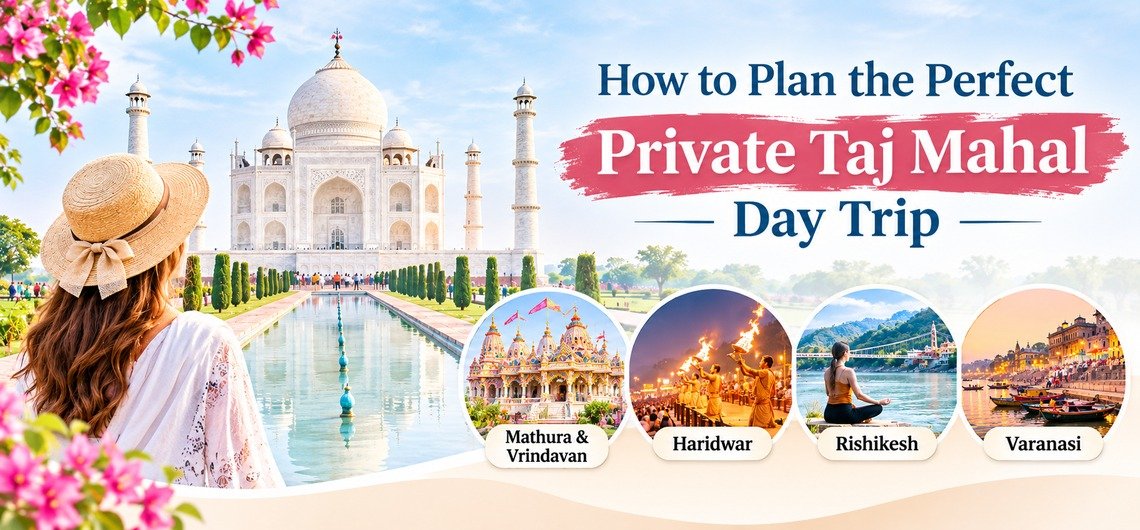
A private Taj Mahal day trip from Delhi is entirely doable: leave early, drive about three to four hours to Agra, see the Taj Mahal and Agra Fort, and return the same evening. The key is a sensible start time, a comfortable car and a guide who helps you use your time well. This guide explains how to plan it, what a realistic one-day itinerary looks like, and how to extend your journey to spiritual destinations such as Mathura, Vrindavan, Haridwar, Rishikesh and Varanasi if you have extra days.
The Taj Mahal needs little introduction. This white marble mausoleum, built by Emperor Shah Jahan in memory of his wife Mumtaz Mahal, is among the most recognisable monuments in the world. For first-time visitors, a well-organised private Taj Mahal tour from companies such as Taj Mahal Private Trip can remove much of the stress of logistics, so you can concentrate on the experience itself.
Why Choose a Private Taj Mahal Day Trip?
A private day trip is built around your schedule rather than a fixed group departure. For couples, families and international visitors new to India, that flexibility often matters more than anything else.
The main advantages are:
- Flexible timings. You can agree on a pickup time that suits you, whether that is a pre-dawn start for sunrise or a more relaxed morning departure.
- Comfortable transportation. A private air-conditioned car makes the long road journey easier, especially with children or older travellers.
- Personal attention. A local guide can tailor explanations to your interests and answer questions as they arise.
- Control over pacing. If you want to linger over the marble inlay work or spend extra time in the gardens, you can.
- Room to explore beyond the headline sights. Many travellers add a craft stop, a local meal or a viewpoint across the river.
Private tour or group tour?
Group tours can be a good, budget-friendly choice, and they work well for travellers who are happy to follow a set schedule. Private tours generally cost more but offer more control over timing, stops and pace. Neither is right for everyone. If you value flexibility, travel with family or have specific interests such as photography or history, a private format tends to suit better. If cost is your top priority and you are comfortable with a fixed itinerary, a group tour may be enough.
How to Plan Your Perfect Taj Mahal Day Trip
A few decisions shape the whole day. Settle these first and the rest falls into place.
Choose the Right Starting Point
Most day trippers start from Delhi. The drive to Agra is roughly 200 kilometres and usually takes around three to four hours via the Yamuna Expressway, depending on traffic and where in Delhi you begin. This is comfortable for a long day but not a short one, so an early start is important.
Jaipur is also possible, but the journey is longer, so a same-day return is tiring. Many travellers from Jaipur prefer to stay a night in Agra instead. If you are already in or near Agra, you have the most flexibility of all.
Decide Between a Sunrise and Regular Day Tour
The two options feel quite different.
- Sunrise visit: Cooler temperatures, softer light and often a calmer atmosphere in the early hours. It is popular with photographers. It also means a very early departure from Delhi, typically in the middle of the night or well before dawn.
- Regular day tour: A more relaxed start, with an easier schedule for families. The light is brighter and the monument is usually busier by mid-morning.
Neither guarantees perfect photographs, since haze and fog can affect visibility, especially in winter. Choose based on your energy levels and priorities rather than expecting a specific result.
Select Comfortable Transportation
For a day trip of this length, a private air-conditioned car with an experienced professional driver is a practical choice. Ask in advance about the vehicle type, luggage space, pickup arrangements and how breaks along the expressway are handled. Clear journey planning helps ensure you reach Agra with enough time to enjoy it.
Hire a Knowledgeable Local Guide
The Taj Mahal is far more rewarding when you understand what you are seeing. A good guide can explain Mughal history, the symmetry of the gardens, the pietra dura inlay of semi-precious stones set into marble, and the stories behind the monument. A guide can also help you move efficiently through security and crowds. Always confirm in advance that your guide is licensed, and avoid unofficial people who approach you at the gate.
Check Entry Tickets and Visiting Rules
Plan these points before you travel:
- Friday closure: The Taj Mahal is generally closed to general visitors on Fridays. Plan your trip for another day of the week.
- Tickets: Tickets are available online and at the site. Booking ahead can save time, and foreign and Indian visitors pay different rates. Check the current prices on the official Archaeological Survey of India channels.
- Security: Expect airport-style security checks. Large bags, food, tripods and certain other items are restricted, so travel light.
- Photography: Photography is allowed in the grounds, but rules apply inside the main mausoleum chamber.
Rules and timings can change, so verify the latest details shortly before your visit.
Perfect One-Day Taj Mahal Tour Itinerary
Below is a realistic sample itinerary for a day trip from Delhi. Exact timings will vary with traffic, season and your preferences.
Early Morning: Departure from Delhi
Your driver collects you from your hotel, ideally between 6:00 and 7:00 AM for a regular tour, or much earlier for sunrise. The Yamuna Expressway is a modern road, so the journey is generally smooth. Plan a short break for tea or breakfast on the way.
Morning: Explore the Taj Mahal
Arrive at the Taj Mahal with time to spare. Commissioned in the 17th century, it took many years and thousands of artisans to complete. Highlights include:
- The great gateway, which frames the first view of the monument.
- The central marble mausoleum with its dome and four minarets.
- Delicate marble inlay work and calligraphy.
- The symmetrical Mughal gardens and reflecting pools.
- The story of Shah Jahan and Mumtaz Mahal, which gives the monument its romantic reputation.
Set aside around two hours so you can explore without rushing.
Late Morning: Visit Agra Fort
Agra Fort, a UNESCO World Heritage Site, is a short drive from the Taj Mahal. This red sandstone fortress served as a Mughal imperial residence and contains palaces, audience halls and mosques. It also has a direct historical link to the Taj Mahal, as Shah Jahan is traditionally said to have spent his final years confined in the fort with a view across the river towards his wife’s tomb. Allow roughly one to one and a half hours.
Afternoon: Lunch and Local Experiences
Agra is known for Mughlai cuisine, with rich curries, kebabs and breads, along with the local sweet petha. Ask your guide or driver for a restaurant that suits your tastes and dietary needs. If time allows, you can also visit a workshop to see marble inlay craftsmanship in the tradition of the artisans who worked on the monument. Treat shopping stops as optional and decline politely if you are not interested.
Optional Stop: Mehtab Bagh
Mehtab Bagh is a garden complex on the opposite bank of the Yamuna River, offering a calm view of the Taj Mahal from across the water. It is especially pleasant in the late afternoon if your schedule allows, and it is a good way to see the monument from a different angle.
Evening: Return Journey
Start the drive back in the late afternoon so you reach Delhi at a reasonable hour. One of the benefits of a private tour is flexibility: if you want to stay a little longer at a viewpoint or leave earlier because you are tired, the schedule can adapt.
A realistic summary: depart early, spend the morning at the Taj Mahal and Agra Fort, have lunch, add Mehtab Bagh if there is time, and return in the evening. Adding too many extra stops can make the day exhausting, so be selective.
Spiritual Destinations to Explore Beyond Your Taj Mahal Day Trip
India’s spiritual traditions are as much a reason to travel as its monuments. If you have additional days, you can extend your Agra visit into a broader journey through North India.
Important: These destinations are not part of a one-day Agra itinerary. Each requires extra travel time, and they should be planned as separate extensions rather than squeezed into a single day.
Mathura and Vrindavan: Discover the Land of Lord Krishna
Mathura and Vrindavan are among the most important destinations for devotees of Lord Krishna. Mathura is traditionally regarded as his birthplace, and Vrindavan is associated with his childhood. Key places include:
- Shri Krishna Janmabhoomi in Mathura.
- Banke Bihari Temple in Vrindavan, known for its lively devotional atmosphere.
- ISKCON Temple, a modern temple welcoming international visitors.
- Prem Mandir, famous for its ornate carved marble and evening illuminations.
The atmosphere here is distinctly devotional, with kirtan singing, temple rituals and busy lanes. Mathura and Vrindavan are relatively convenient additions to a longer Delhi and Agra itinerary, as they lie roughly an hour or so by road from Agra. If this appeals, consider a Golden Triangle tour with Mathura and Vrindavan, which combines the famous monuments with these sacred towns. Temples often have specific darshan timings and closing hours in the afternoon, so check the schedule locally.
Haridwar: Experience the Sacred Ganga Aarti
Haridwar is where the Ganges leaves the mountains and enters the plains, and it is one of Hinduism’s major pilgrimage towns. The highlight is the evening Ganga Aarti at Har Ki Pauri, where priests perform fire rituals as lamps and floral offerings float down the river. Pilgrims also bathe in the Ganges here as an important devotional tradition.
Haridwar is a considerable distance from Agra, generally a long full day of driving or a combination of train and road, so it needs to be planned with additional days and an overnight stay.
Rishikesh: Explore Yoga and Meditation
Rishikesh, a short distance from Haridwar, is widely known as a centre for yoga and meditation. Visitors typically explore:
- Parmarth Niketan, an ashram known for its evening aarti and yoga programmes.
- Triveni Ghat, a riverside ghat used for bathing and ceremonies.
- Ram Jhula and Laxman Jhula, the iconic pedestrian suspension bridges over the Ganges.
Rishikesh suits travellers looking for spiritual relaxation, wellness and a slower pace after busy sightseeing. If yoga is a priority, you can explore options such as India yoga tour packages that include structured sessions and ashram-style experiences, rather than trying to arrange classes yourself.
Varanasi: Discover India’s Ancient Spiritual Heritage
Varanasi is among the oldest continuously inhabited cities in the world and a deeply significant destination for Hindus. Highlights include:
- Dashashwamedh Ghat, the main ghat for the grand evening Ganga Aarti.
- Kashi Vishwanath Temple, one of the most revered Shiva temples.
- Morning boat rides on the Ganges, offering a view of life along the ghats at dawn.
- Traditional spiritual and cultural experiences woven through the city.
Varanasi is far from Agra and is better suited to a separate multi-day extension, usually reached by flight or train. It is an intense and memorable place, so allow time to absorb it.
How to Choose the Right Spiritual Extension
| If you are looking for | Consider |
|---|---|
| Krishna devotion and temple culture | Mathura and Vrindavan |
| The Ganga Aarti ritual and pilgrimage traditions | Haridwar |
| Yoga, meditation and wellness | Rishikesh |
| Ancient spiritual traditions and riverside rituals | Varanasi |
Can You Combine a Taj Mahal Tour with a Spiritual Journey?
Yes. Many travellers begin with the Taj Mahal and then extend their trip. The right combination depends on how many days you have, your interests and how much time you are willing to spend in transit. Some common patterns include:
- Agra + Mathura + Vrindavan: A compact option for those who want monuments and Krishna heritage together.
- Delhi + Agra + Haridwar + Rishikesh: A longer itinerary combining heritage with Ganga rituals and yoga.
- Delhi + Agra + Jaipur + Varanasi: The Golden Triangle followed by a spiritual extension to the ghats of Varanasi.
- Golden Triangle with a yoga and wellness experience: For those who want sightseeing balanced with relaxation.
If you would like help shaping such a journey, you can learn more about spiritual tours in India offered by Taj Mahal Private Trip. Share your available dates and interests, and an itinerary can be planned around them, whether you prefer a short add-on or a longer pilgrimage-style route.
Best Time to Plan a Private Taj Mahal Day Trip
The Taj Mahal can be visited year-round, but conditions vary.
- October to March: Generally the most pleasant weather for sightseeing, with cooler days. Winter mornings can bring fog or haze, which may affect early-morning visibility and sometimes road travel.
- April to June: Hot summer conditions. Start early, carry water and plan to rest in the afternoon.
- July to September: Monsoon season, with rain and humidity. The landscape is greener and crowds can be lighter, though showers may interrupt plans.
Sunrise versus sunset: Sunrise visits tend to feel cooler and quieter, while later visits are easier on schedules. Remember that the Taj Mahal is not open for general visits on Fridays.
Be aware that peak tourist seasons and festival periods, including major national holidays, can bring larger crowds and busier roads. Check dates before booking, and treat any weather expectations as general patterns rather than guarantees.
Essential Tips for a Hassle-Free Taj Mahal Day Trip
- Book tickets in advance where possible to avoid long queues.
- Carry valid identification, such as your passport or a copy, as it may be needed for ticketing.
- Wear comfortable footwear. You will walk a fair amount, and shoe covers or bare feet may be needed near the mausoleum.
- Dress appropriately. Light, breathable clothing that covers shoulders and knees is respectful and practical.
- Carry drinking water and sun protection, particularly in warmer months.
- Follow photography rules, including restrictions inside the main chamber.
- Avoid unofficial guides who approach you near entrances.
- Allow extra time for traffic, especially on weekends and holidays.
- Check opening days and current rules shortly before you travel, since policies can change.
- Travel light. Security restrictions limit what you can bring in.
Why Plan Your Taj Mahal Trip with Taj Mahal Private Trip?
Planning a day trip involves many small decisions, and working with a local travel company can simplify them. Taj Mahal Private Trip focuses on private travel in North India, including heritage, cultural and spiritual journeys. Travellers can ask about:
- Customised private itineraries built around their dates and interests.
- Comfortable private transportation for road journeys.
- Local travel assistance during the trip.
- Guided sightseeing at the Taj Mahal and other attractions.
- Flexible schedules for sightseeing.
- Cultural, heritage and spiritual travel options beyond Agra.
Frequently Asked Questions
1. How much time is needed for a private Taj Mahal day trip?
Plan for a full day, roughly 12 to 14 hours from Delhi. This includes about three to four hours of driving each way, plus time at the Taj Mahal and Agra Fort.
2. Is a private Taj Mahal tour worth booking?
For many travellers, yes. A private tour offers flexible timings, a comfortable car and personal guidance, which is helpful for families, couples and first-time visitors. If budget is your main concern, a group tour is a reasonable alternative.
3. Can I visit the Taj Mahal and Agra Fort in one day?
Yes. They are close to each other, and most day itineraries cover both, with time for lunch. Adding other stops depends on traffic and your pace.
4. What is the best time to start a Taj Mahal day trip from Delhi?
A departure between 6:00 and 7:00 AM works for a regular tour. For a sunrise visit, you will need to leave much earlier, usually during the night.
5. Can I visit Mathura and Vrindavan after the Taj Mahal?
It is possible with an extended itinerary, as they are not far from Agra. However, it is usually better to plan an extra day rather than rushing them after a full Agra day, since temple visits take time.
6. How many days are required to explore Haridwar and Rishikesh?
Plan at least two to three days for both, not counting the travel time to reach them. More time is helpful if you want yoga sessions or a slower pace.
7. Can I combine a Taj Mahal tour with a spiritual tour in India?
Yes. Many travellers extend a Delhi and Agra trip with Mathura, Vrindavan, Haridwar, Rishikesh or Varanasi, depending on the days they have.
8. Is a private car better for travelling from Delhi to Agra?
A private car offers door-to-door convenience and flexible stops, which many travellers find helpful. Trains are another option, but they require transfers at both ends and follow fixed schedules.
9. Is the Taj Mahal open every day?
No. It is generally closed to general visitors on Fridays. Check current timings and rules before you travel.
10. What should I carry for a same-day Agra tour?
Carry your ID or passport copy, tickets, water, sun protection, comfortable shoes, a light layer and a small bag. Avoid large bags and restricted items.
Conclusion
A well-planned private Taj Mahal day trip is a comfortable way to experience Agra’s most famous attractions, from the marble beauty of the Taj Mahal to the red sandstone grandeur of Agra Fort. With the right start time, transport and guide, you can see the highlights without feeling rushed.

Comments